Skip to content

Air Conditioner Cost per Hour

Updated July 2026 rate dataHeating & CoolingSourced from U.S. EIA

A unit's draw follows its cooling capacity and efficiency rating, so a bigger room or a hotter afternoon means more compressor runtime. Pick your unit's size, your daily hours, and your state below to price it.

Quick pick

EIA residential average, July 2026. Your utility's exact rate is on your bill.

Rate applied
18.31¢ /kWh
U.S. average

900 W
300 W4,200 W
8 h
1 h24 h
Common setups

Live cost meter · running at your current settings
$0.00000
since you opened this page · 0:00 elapsed
0.90 kW · 0.0000 kWh burned
burn rate
$0.16/hr
24/7 ≈ $120/mo

Real-time math: 900 W × your state's rate, accumulating live. Thermostatically controlled units cycle on and off, so average use is usually below the flat-out figure.

Per hour
$0.16
Per day
$1.32
7.2 kWh
Per month
$40.10
219 kWh
Per year
$481
2,628 kWh

Run like this for a year and it adds about $481 to your electricity bill.

Power draw estimates from BTU rating and efficiency (watts ≈ BTU/hr ÷ EER); a 10,000 BTU/hr unit drawing 900 W implies an EER of about 11.1. Rate basis: 18.31¢/kWh U.S. average (EIA, July 2026). Compressor cycling lowers real-world cost.

Energy: 7.2 kWh per day · 2,628 kWh per year, at 18.31¢/kWh (U.S. average).

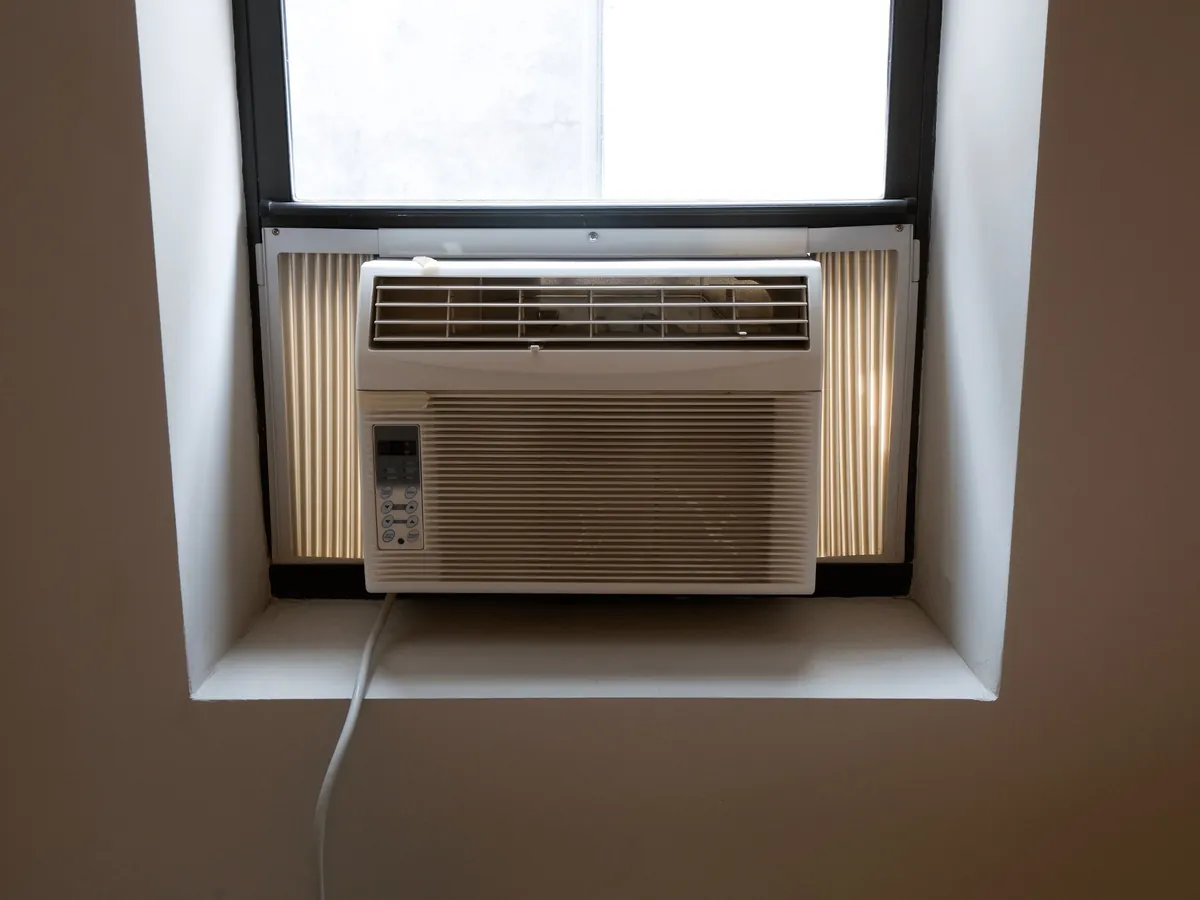
A window air conditioner installed in a sunlit residential window

How many watts does an air conditioner use, and what does it cost to run?

Wattage is the number that decides everything else. The table below runs the actual figures through this page's calculator at the U.S. average rate of 18.31¢ /kWh, so you can see the running cost jump as the load climbs. Change any value above and the whole page recalculates.

Watts and running cost for an air conditioner at the U.S. average rate
WattsPower drawPer hourPer month (8 h/day)
300 W300 W draws 0.30 kW$0.055$13.37
1,600 W1,600 W draws 1.60 kW$0.29$71.29
2,900 W2,900 W draws 2.90 kW$0.53$129
4,200 W4,200 W draws 4.20 kW$0.77$187

Basis: July 2026 U.S. average residential rate of 18.31¢ /kWh (EIA Electric Power Monthly, Table 5.6.A). Your state's rate is applied as soon as you pick it above.

What changes the number

BTU rating and EER

An AC's power draw is its cooling capacity (BTU/hr) divided by its efficiency (EER). A 10,000 BTU/hr unit drawing 900 W has an implied EER of about 11.1; at EER 12, it draws about 830 W for the same cooling. The EnergyGuide label lists the exact watts and yearly cost estimate for your model.

Compressor duty cycle

The compressor doesn't run every second. Once the room reaches the setpoint it cycles off; in milder weather a unit might draw full power only half the time. Hot afternoons with a big cooling gap push duty cycles toward 100%.

Window vs. central

Central systems cool the entire house, so their hourly cost is several times a window unit's — but per degree of cooling across the whole home they can be comparable. Cooling one occupied room with a window unit is almost always the cheaper strategy for a household.

Your state rate

The same 10,000 BTU unit costs about $0.115 per hour in Nevada and $0.432 per hour in Hawaii. Summer bills concentrate this: 200 hours of July runtime means a $22.99–$86.40 spread between states.

Cut the cost

Biggest savings first.

  1. Every degree higher on the thermostat cuts compressor runtime; 78°F with a fan beats 72°F on cost every time.
  2. Clean the filter monthly in season — a clogged filter makes the unit run longer for the same cooling.
  3. Close blinds on sun-facing windows; solar gain is what the compressor fights hardest.
  4. Use the timer so the AC pre-cools before you arrive home instead of running all day.
  5. If your unit is 10+ years old, a modern ENERGY STAR replacement often delivers the same cooling for 10–20% less power.

Frequently asked questions

How much does it cost to run AC for 24 hours?

A 10,000 BTU window unit (≈900 W) running 24 hours flat-out uses about 21.6 kWh — roughly $4 at the U.S. average rate (18.31¢/kWh). A 3-ton central system flat-out would be about $16. Real bills are lower because compressors cycle.

How much does AC cost per month in summer?

At 8 hours a day, a 10,000 BTU window AC is about $31/month at the U.S. average rate. Central AC at the same daily schedule runs roughly $85–125/month depending on tonnage and rate. Duty cycle and insulation swing these numbers a lot.

How many watts does an air conditioner use?

Window units: 5,000 BTU ≈ 500 W, 8,000 BTU ≈ 720 W, 10,000 BTU ≈ 900 W, 12,000 BTU ≈ 1,060 W (at a typical EER of 10). Central systems: about 1,200 W per ton, so 2-ton ≈ 2,400 W and 3-ton ≈ 3,600 W.

Is it cheaper to leave AC on all day or turn it off?

Turning it off (or setting it well higher) while you're out wins in most homes. 'All day' running only makes sense with a very efficient envelope or a utility rate that penalizes evening peak use — a programmable thermostat pre-cooling an hour before you return is the practical middle ground.

Sources

Rate basis: EIA residential average, July 2026 (retrieved from Electric Power Monthly Table 5.6.A). Estimates are for planning, not billing.

Keep calculating